Competitive brewing.
Thirty-three competitions across seven countries and six brewing disciplines — Brewers Cup, Coffee in Good Spirits, Ibrik, Aeropress, Comandante Cup and Moka — plus Cup Tasting and the Creators Cup. Romanian Brewers Cup champion, and 34th in the world at the 2026 World Brewers Cup in Brussels.
Brussels
World Brewers Cup · WoC Brussels, June 2026
Contrast preservation across a cooling arc — a cup whose fruit resolves as it drops in temperature, from strawberry and red apple through to ripe cherry and caramel, with hibiscus holding steady underneath at every stage. The presentation borrowed my day job: reading a cup the way you read a tissue section under the microscope, one focal plane at a time.
- Competition
- World Brewers Cup
- Result
- 34th
16th in Europe - Coffee
- CGLE-17
Geisha × Caturra, Colombia - Focus
- Water chemistry
soft, low-buffer profile
My first World Brewers Cup — and one I went into with a standard in mind. Romania has set a high bar here: Alex Niculae, World Roasting Champion in 2016, took the top open service score of the 2024 field in Chicago — 376, ahead of every competitor in Round One, and still the highest recorded under the current scoresheet. That number is the benchmark I was trying to honour, not just a placing to chase.
Drippers sat directly on the servers with no base, so they brewed off-level. I rushed the WDT after nearly forgetting it. I lifted the cup to pour instead of leaving it on the counter.
None of it was the recipe. All of it was the hands — the encouraging kind of mistake to make.
The cup
Sensory profile · as delivered to the judges
Hibiscus runs through every stage. Everything else moves as the temperature drops: strawberry and red apple in the hot cup, with a jam-like sweetness and a long, malic finish — maturing, as it cools, into ripe dark cherries, a hint of caramel and chamomile, the body turning from silky to juicy.
A clean, fruity, and balanced cup.
B.R.E.W.
The four variables · Brussels build
Four levers, one goal: a cup that resolves as it cools rather than fading — strawberry and red apple giving way to ripe cherry and caramel, with hibiscus threading through every stage. Every decision below was made in service of that arc.
Beans
Geisha × Caturra hybrid — "CGLE-17"
Café Granja La Esperanza · Potosí Farm, Colombia
A hybrid that pairs the aromatic ceiling of a Geisha with the sweetness and structural backbone of a Caturra — the acidity holds its shape as the cup cools instead of thinning out, which is what lets the fruit resolve across the whole tasting window rather than fading.
Roasting
Light roast · 10 days rest
Light enough to leave the varietal aromatics intact — roast character would be the fastest way to collapse four distinct fruits into one caramel note. Ten days is the window where the CO₂ has settled enough for an even extraction, but the volatile top notes haven't yet faded.
Equipment
Origami Pinn dripper · Cafec filters · Icosa Cyclone server · Icosa Avensi Wave porcelain cups · Nucleus Bloom WDT · Acaia scales
A brewer and paper chosen for clarity over body — the goal is a clean, high-separation cup where notes stay resolved — with the WDT removing the channeling that would otherwise muddy those distinctions. Server and cups share one philosophy: a round body narrowing to a tight rim, which pushes the coffee onto the centre of the palate and folds it into a concentrated aroma at every sip.
Water
Mg : Ca : K — 4 : 3 : 1 @ 115 ppm
The lever I care most about. Magnesium-forward for extraction of the fruit aromatics, with the buffering kept deliberately low — carbonate hardness rounds off acidity, and rounded acidity is exactly what turns a sharp apple into a vague sweetness. Low buffer keeps the edges on.
Writing
Cafecedar — the Romanian coffee lexicon
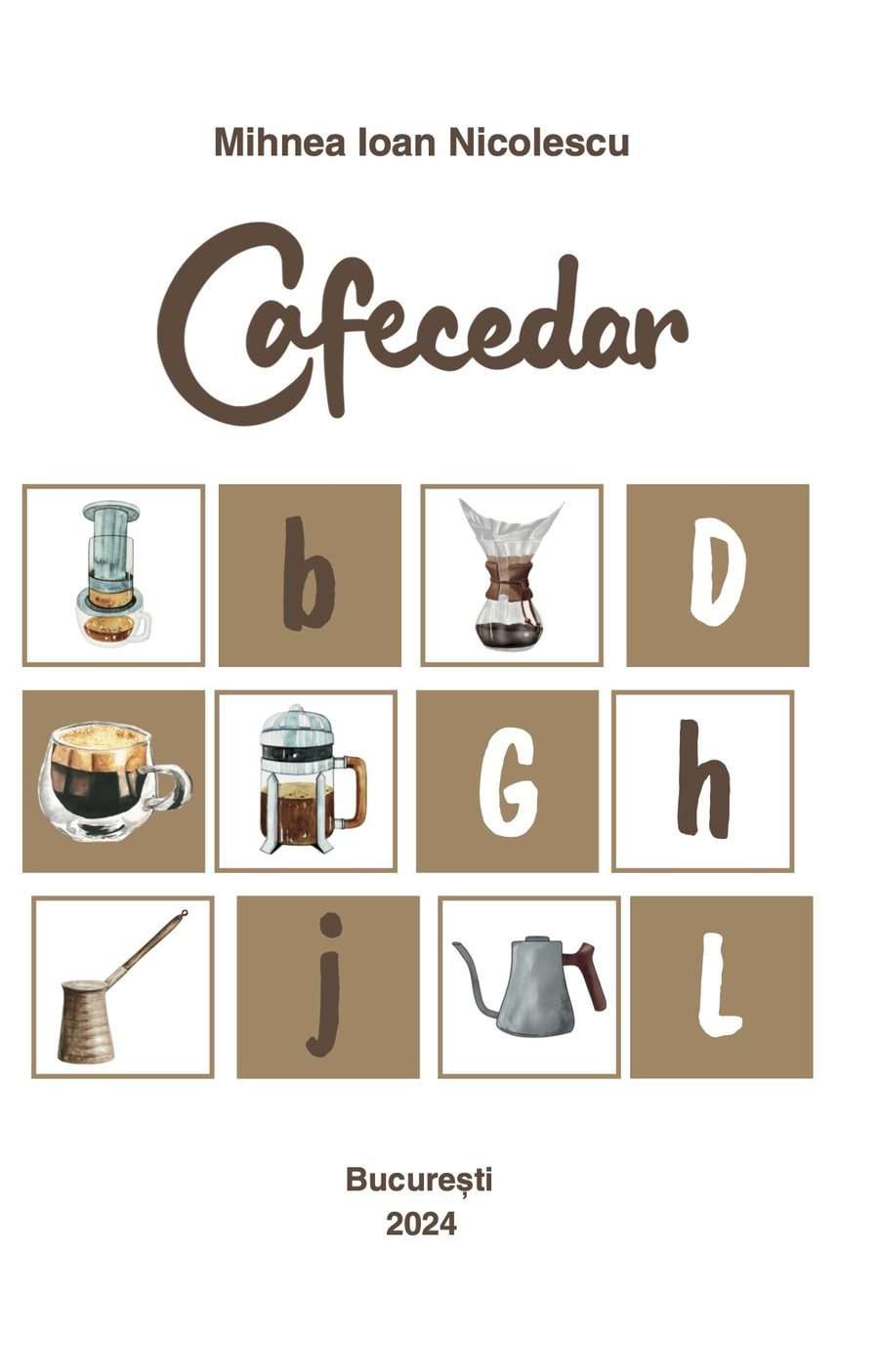
Cafecedar is a pocket lexicon of 150 terms from the world of coffee — characteristics, brewing methods, equipment, drink types, and the language of sensory perception.
An A-to-Z built on the same conviction that drives my teaching: that precise words make a sensory experience shareable. The title blends cafea (coffee) with abecedar — the ABC primer every Romanian child first learns to read from — which is why the cover runs the alphabet across tiles of brewing gear. Hidden in the ending is ce dar, "what a gift": a small gift of knowledge.
- Edition
- First, 2024
- Place
- Bucharest, RO
- Terms
- 150
- ISBN
- 978-973-0-40677-1
Competition record
33 entries · 2018 — 2026